


- Home
- A-Z Publications
- Technoetic Arts
- Issue Home
Technoetic Arts - Current Issue
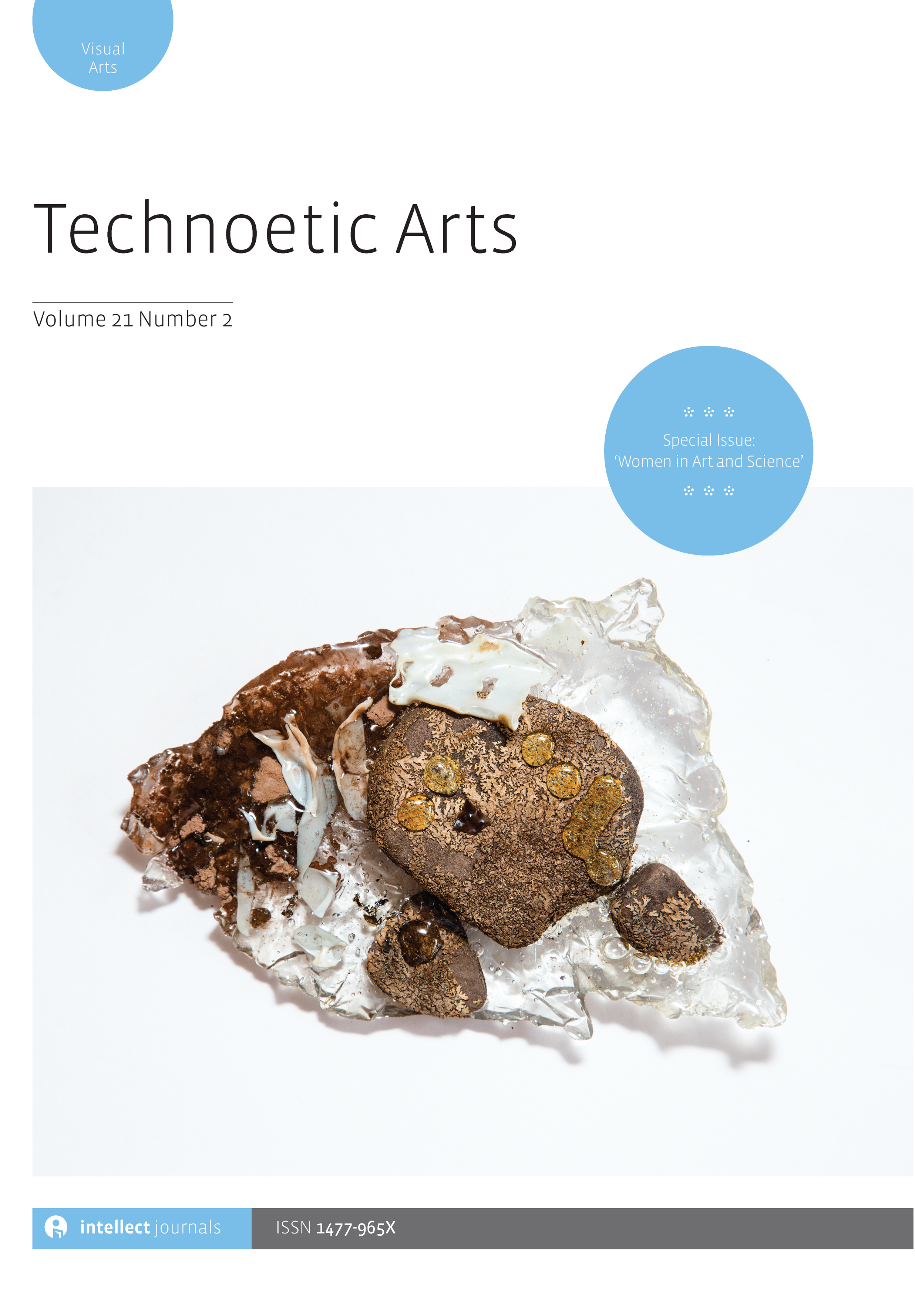
Women in Art and Science, Oct 2023
- Editorial
-
-
-
Women’s agency in art and science
More LessAuthors: Dalila Honorato and Claudia WestermannWomen in the field of art and science have an unquestionable presence worldwide that exceeds their visibility in the general visual art scene. When cataloguing women’s range of practices and exploring their agency in art and science, a new model of inclusivity and access to the public sphere for all individuals working in art emerges. First, these are contributions reflecting on projects being carried out by women in the broadest interpretation of the term – individuals who identify themselves as women, cisgender, non-cisgender, transgender, gender fluid and independent of their sex and gender. Second, these are contributions that reflect on research methodologies, collaboration strategies, knowledge sharing, as well as public vs. personal, embodiment and materiality.
-
-
- Articles
-
-
-
Algorithmic bias in anthropomorphic artificial intelligence: Critical perspectives through the practice of women media artists and designers
More LessCurrent research in artificial intelligence (AI) sheds light on algorithmic bias embedded in AI systems. The underrepresentation of women in the AI design sector of the tech industry, as well as in training datasets, results in technological products that encode gender bias, reinforce stereotypes and reproduce normative notions of gender and femininity. Biased behaviour is notably reflected in anthropomorphic AI systems, such as personal intelligent assistants (PIAs) and chatbots, that are usually feminized through various design parameters, such as names, voices and traits. Gendering of AI entities, however, is often reduced to the encoding of stereotypical behavioural patterns that perpetuate normative assumptions about the role of women in society. The impact of this behaviour on social life increases, as human-to-(anthropomorphic)machine interactions are mirrored in human-to-human social interactions. This article presents current critical research on AI bias, focusing on anthropomorphic systems. Moreover, it discusses the significance of women’s engagement in AI design and programming, by presenting selected case studies of contemporary female media artists and designers. Finally, it suggests that women, through their creative practice, provide feminist and critical approaches to AI design which are essential for imagining alternative, inclusive, ethic and de-biased futures for anthropomorphic AIs.
-
-
-
-
Re-enacting/mediating/activating: Towards a collaborative feminist approach to research-creation
More LessWorldwide interest in understanding art and creative practices as valid forms of knowledge production has led to the establishment of research-creation as an interdisciplinary academic field in the last twenty years in Canada as elsewhere. Its establishment relates to a growing interest in critical making and technological innovation and to the legacies of feminism(s) and its critique of the power dynamics of knowledge production within academia. This article outlines a series of interactive projects that bring visibility to Latin American women in art, science and technology and speculates on the legacies of feminism(s) in the emergence of research-creation. The four projects discussed build on each other and explore re-mediation, re-activation and re-enactment as part of a collaborative feminist research-creation methodology. I theorize their potential to activate political memory by highlighting how these three approaches to creation share a preoccupation for revisiting the past through repetition, iteration and the facilitation of intergenerational encounters among humans, non-humans and across media and technologies. While discussing the feminist orientation of these approaches, I suggest a critique of dominant modes of knowledge production that have obscured the contributions of Latin American women and offer four research-creation interventions in the media arts archive.
-
-
-
Suzanne Ciani: The diva of the diode
More LessBy Hussein BoonThe world of synthesizers and synthesists is historically male-dominated. Women in synthesis tend to be obscured by males, and their contribution suffers from erasure. This article considers Suzanne Ciani within the contexts of art, technology, science and culture and her work in composition, performance and media. In particular, her National Endowment for the Arts report of 1976 is a groundbreaking document detailing her composition and performance process using synthesizers. Her composition approach has parallels with techniques drawn from serialism, performed and improvised live using machines. Her performances utilize quadraphonic techniques for spatialized performance as part of the composition and performance. She was the first woman to score a major Hollywood film in 1981. Her work in media and technology highlights a space that women have always worked in but have frequently not been acknowledged as doing so. Ciani’s story reveals tenacity in the face of bias and rejection. It is a tale of someone who always has to claim her credentials, always legitimate her mode of expression, and always counter the assumption that somewhere in her work, there is a man.
-
-
-
Taboo in world cinema: Female protagonists within incestuous relationships
More LessAuthors: Styliani Anna Klimatsaki and Dalila HonoratoThis article examines, analyses and compares the cinematic representation of three female protagonists (on three respective films) within their portrayed incestuous relationships. It also attempts to draw significant conclusions about their dynamic as female participating subjects in these affairs in a more inclusive way, one that takes into consideration their racial, gender, social and family characteristics. As incest itself is one of the strongest human taboos, various questions regarding the female portrait and position in such relationships arise: as incest constitutes the strongest social taboo of human civilization, is it similarly portrayed in cinema? Can incest be a female’s act of choice or is it just a male’s one? Are there any differences between male and female depictions of incestuous desire and sexual act? In which ways do potential differences, such as social status, class origin, racial and gender stereotypes, influence the protagonists of incestuous relationships? Which female motivations are involved in incestuous relationships?
-
-
-
Reinterpreting the pretty picture: A speculative aesthetics of microscopy
More LessThis article looks at the positioning of the aesthetic in microscopy to understand how it can be both side-lined and deployed. It considers the boundary between the pictorial and the notational in current microscopy practice and speculates on a space of mutual relation. Microscopy’s dual threads of capture for data analysis and capture for publication reveal complicated relationships and conflicted stances, reflective of a broader iconoclastic tendency in microscopy where the image as enacted perception is erased while the notation generated and carried by these images is preserved. This article seeks to suggest a space in which phenomena are situated, materially embedded and emergent through imaging practices. I ground my position on experimental imaging of bacterial iridescence to consider the entanglement of microscopy’s living image with its processes of making-seen. Microscopy is instrumental in supporting descriptive-explanatory claims on biological life yet is also implicated in the generation of novel, hybrid phenomena and sensibilities. Exploring both tendencies exposes a microscopy of permeable membranes and suggests alternative orientations through microscopy practice and its images.
-
-
-
BioDwelling: A participatory approach to living with living material
More LessAuthors: Louise Mackenzie and Kaajal ModiBioDwelling is an arts-led research project that brings ethical concerns of culture, gender and multispecies relationality from the feminist technosciences into direct conversation with the emerging field of biotechnological architecture (bio-architecture). Working within a multi-disciplinary bio-architecture research group, we develop a practice-led methodology to facilitate the exploration of questions that arise when we begin to engineer more-than-human dwelling spaces. In this article we give a brief overview of the work of the Hub for Biotechnology in the Built Environment (HBBE) and the Responsible Interactions research theme, which outlines the project context. We go on to describe the BioDwelling methodology and introduce three arts-led interventions that draw on feminist science and cultural theory to invite reflections on the ethical implications of working with living materials to build (or grow?) spaces in which humans intend to live. We conclude with a summary of the project to date, reflections on methods and possible next steps.
-
-
-
Anarchiving the Anthropocene: Waste and relationality
More LessThe archive produces a linear time that reaches towards ‘what could be’ by asserting ‘what has been’, providing us reassurance of our existence through the assertion of a reliably past past. But the Anthropocene is an era of uncontained material ramifications, where the past juts into the future and temporality warps as change accelerates unexpectedly. As an ecological and geologic epoch, documentation of the Anthropocene inherently has a relationship to natural history museums and archives. These institutions, however, troublingly rest on what Elaine Graham calls ‘ontological hygiene’ – the separateness of the human subject from ‘nature’. The Anthropocene however, challenges the western post-Enlightenment binary of man vs. nature, as it (supposedly) naturalizes humans into an earth systems force. As such, documentation of this epoch might resist ontological sanitation. This article outlines an artistic research practice to create artefacts of the Anthropocene – one that invites material idiosyncrasies, objects-in-becoming, ephemerality, and decay. I suggest that artistic ‘anarchices’ prioritize process over objects, and resist linear and static representation in lieu of material, embodied and sensory artefacts. These include relational encounters with waste materials, reworked forms of ‘geology’, edible artefacts and multimedia works at landfills and feral sites. The anarchives are interpolated by a rejection of hegemonic logic, positivism and ‘objective’ truths about environmental phenomena; Situated, ambiguous and material knowledges are inwrought into the so-called Anthropocene (and any alternatives to this term). By focusing on waste as an analytical category, I explore some of the ontological breakdowns present in the Anthropocene and question how to unorder systems and disturb materiality.
-
-
-
Cryptic insect soundscapes: Ecological sound art as a prompt for auralization
More LessMuch insect sounding is beyond the limits of typical human hearing ability. This sonic separation is exacerbated by a socialized narrative of fear and avoidance of insects in many western societies. With the use of audio technologies to expand our senses, we can embrace opportunities to get to know sensory and communicative insect sound-worlds beyond our own. Ecological sound art – sound art that has an environmentalist intent – is a tangible and accessible means of listening to these sounds. In the series Built Hidden Soundscapes, the primary author (Schonberg) composes imagined soundscapes existing solely of sounds that are beyond the limits of typical human hearing ability. In this article we introduce two compositions in this series, Reserva Florestal Adolpho Ducke and Pipeline Road. These compositions offer a temporary expansion of our aural senses that can increase listeners’ awareness of cryptic insect existences/ecologies. We suggest that this listening practice might prompt future auralization (sounding or hearing in the mind) of insect sound for the listener.
-
Volumes & issues
-
Volume 21 (2023)
-
Volume 20 (2022)
-
Volume 19 (2021)
-
Volume 18 (2020)
-
Volume 17 (2019)
-
Volume 16 (2018)
-
Volume 15 (2017)
-
Volume 14 (2016)
-
Volume 13 (2015)
-
Volume 12 (2014)
-
Volume 11 (2013)
-
Volume 10 (2012)
-
Volume 9 (2011 - 2012)
-
Volume 8 (2010 - 2011)
-
Volume 7 (2009)
-
Volume 6 (2008 - 2009)
-
Volume 5 (2007)
-
Volume 4 (2006)
-
Volume 3 (2005)
-
Volume 2 (2004)
-
Volume 1 (2003)
Most Read This Month Most Read RSS feed
